



De zingende stad
Departing from the fact that an international festival for children and youth which positions youth opera at the heart of society, Yo! Opera realised in 2006 that it needed to investigate the role new media could play in its activities. This idea led to a research assignment of the Yo! Opera Festival to a group of students at the Hogeschool voor de kunsten [School of the Arts] in Utrecht at the faculty of Art, Media & Technology. It resulted not only in a set of inspiring recommendations, but also in several concrete plans, which in 2008 led to a multimedia cultural education project: De Zingende Stad [The City Sings].
De Zingende Stad came into existence in collaboration with the Waag Society and it was ultimately meant to be a multimedia music project. The project was based on the so called 'songlines' of Australian Aborigines. There thousands of songlines; criss cross routes all over Australia. The routes are not indicated on any map; they are passed from generation to generation in songs. Songlines are used to mark religious, spiritual and territorial boundaries. One could say that they map the vocal world. In that way, everyone knows who lives where, or where they are from. But also where water can be obtained, or if dangers threaten.
Starting from this tradition, Yo! Opera wanted to create modern songlines together with opera makers, children and youth, on today's world of mobile phones and the internet. De Zingende Stad became an art project on how your own world can be meaningful to you and how this world can take on a new meaning. In De Zingende Stad, the word songlines was translated into the Dutch word 'zangsporen' [songtrails].
Everyday surroundings offer both a source of inspiration and a stage for singing. Everyone can sing the praises of a favourite spot in town with a song, with a collage of sounds or even a cry. By using your mobile phone, you can record, listen to or look at your own songtrail while taking a walk. The songtrails can then be mapped with the help of a gps-connection. Next, these vocal maps can be found on the internet.
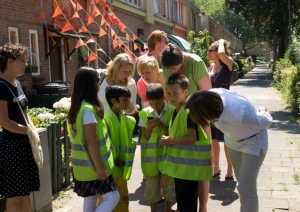
The aim of the project was to make children and teachers aware of their voices and to encourage them to sing. Pupils used mobile phones, with access to the internet and gps, to create games together, play these games and to view and evaluate the results afterwards. The learning environment of the children consisted not only of the class room, but also of the area around the school. This meant that the children acquired knowledge by a location-based method: they literally made a vocal map of their surroundings.
The project had several interesting results. The combination of a digital teaching method and creativity (singing) resulted in a miraculous chemistry; the magic circle effect. Within the context of the game, children were totally absorbed by it and showed a lot of guts. The use of new media in De Zingende Stad made it easier to use their voices or sing, while in a normal classroom situation they would feel more shame or be more nervous. Apart from that, the encouragement of creativity by means of digital tools appeared to increase parents' interest in their children's achievements, which is an important factor at special needs schools.
It was for good reason that Yo! Opera invested heavily in the project. Connecting singing and a relevant context at schools brought several important themes together in one project: media literacy, learning, creativity, identification, empowerment and a sense of ownership were some of the most valuable results of the project. Elaborate tests performed by Yo! Opera at schools such as the Utrecht Rietendak School were promising. The research conducted by Sandra Trienekens of Hogeschool Amsterdam during this testing phase clearly put forward the positive aspects of this project.
De Zingende Stad came into existence in collaboration with the Waag Society and it was ultimately meant to be a multimedia music project. The project was based on the so called 'songlines' of Australian Aborigines. There thousands of songlines; criss cross routes all over Australia. The routes are not indicated on any map; they are passed from generation to generation in songs. Songlines are used to mark religious, spiritual and territorial boundaries. One could say that they map the vocal world. In that way, everyone knows who lives where, or where they are from. But also where water can be obtained, or if dangers threaten.
Starting from this tradition, Yo! Opera wanted to create modern songlines together with opera makers, children and youth, on today's world of mobile phones and the internet. De Zingende Stad became an art project on how your own world can be meaningful to you and how this world can take on a new meaning. In De Zingende Stad, the word songlines was translated into the Dutch word 'zangsporen' [songtrails].
Everyday surroundings offer both a source of inspiration and a stage for singing. Everyone can sing the praises of a favourite spot in town with a song, with a collage of sounds or even a cry. By using your mobile phone, you can record, listen to or look at your own songtrail while taking a walk. The songtrails can then be mapped with the help of a gps-connection. Next, these vocal maps can be found on the internet.
The aim of the project was to make children and teachers aware of their voices and to encourage them to sing. Pupils used mobile phones, with access to the internet and gps, to create games together, play these games and to view and evaluate the results afterwards. The learning environment of the children consisted not only of the class room, but also of the area around the school. This meant that the children acquired knowledge by a location-based method: they literally made a vocal map of their surroundings.
The project had several interesting results. The combination of a digital teaching method and creativity (singing) resulted in a miraculous chemistry; the magic circle effect. Within the context of the game, children were totally absorbed by it and showed a lot of guts. The use of new media in De Zingende Stad made it easier to use their voices or sing, while in a normal classroom situation they would feel more shame or be more nervous. Apart from that, the encouragement of creativity by means of digital tools appeared to increase parents' interest in their children's achievements, which is an important factor at special needs schools.
It was for good reason that Yo! Opera invested heavily in the project. Connecting singing and a relevant context at schools brought several important themes together in one project: media literacy, learning, creativity, identification, empowerment and a sense of ownership were some of the most valuable results of the project. Elaborate tests performed by Yo! Opera at schools such as the Utrecht Rietendak School were promising. The research conducted by Sandra Trienekens of Hogeschool Amsterdam during this testing phase clearly put forward the positive aspects of this project.