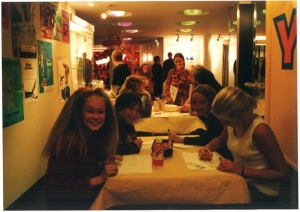
Yo! Opera Festival 2001
The first Yo! Opera Festival sprang from the conviction that youth opera must be able to develop into a full and independent genre. Many initiatives from other artistic disciplines served as an example: Tweetakt (theatre), Cinekid (film) and the Kinderboekenweek [Children's Book Week] (literature). This first festival took place at the Utrecht Stadsschouwburg [City Theatre], which also co-produced the event. The organisation was in the hands of Anthony Heidweiller (artistic director) and Saskia van de Ree (producer), supported by project staff and employees of the city theatre.
The first edition of the festival was received very well by all companies participating in the festival, professionals attending the conference, and of course by its audience. A surprisingly large number of visitors (approximately 5000) witnessed the great variability in the programme items and the fringe events. It appeared that the language barrier in some of the performances, especially in operas from Northern Europe and Dutch repertoire, caused no problems whatsoever. Also the choice to offer a programme for various target audiences – both shows for the littlest ones and youth opera – was much appreciated by the audience.
The festival programme offered performances by Dutch companies such as Xynix Opera (Zieltje [Little Soul]), Prima Rima/Berenkuil, (Kleine, kleine zeemeermin [Little, Little Mermaid]) and Theater VanDenBulck (Beren, beren, beren [Bears, Bears, Bears]). Also Frank Groothof, a well-known figure in the Dutch theatre and television world, was present, performing his music theatrical show De Toverfluit [The Magic Flute]. Heidweiller's own company Buffo Operamakers treated the audience to Slik/Patatje Oorlog [Gulp/Chips].
Audience favourites were the shows performed in the main hall of the theatre: Frank Groothof's De Toverfluit [The Magic Flute] and a beautiful, expressive opera from Finland entitled Poy, suitable for a very young audience (3+) and carried by a very strong composition by Glenn Erik Haugland and a libretto in a fantasy language. The piece Gaia by the Finnish National Opera also offered beautiful music, which made up for the language barrier. Of Belgian origin was De Tooverfluit by the music theatrical innovators of Het Muziek Lod in collaboration with Het Paleis. Also from Belgium was De Storm (directed by Wouter van Looy) by Music Theatre Company Transparant, another institution focussing strongly on the development of the operatic genre. This was the only production showing youth on stage: a crucial element in offering a young audience the chance to identify with the main characters. The performance Wolfgang, caro mio! by the French company Arcal offered a totally different view on opera. Young, inexperienced singers brought a charming composition of songs and spoken words, making a nice change to the rest of the festival programme.
Since festival master classes and workshops were offered parallel to the rest of the programme, the festival also offered many opportunities for professional visitors. They could also attend an international working conference, which attracted many professionals from all over Europe, to talk about the development of the youth operatic genre. Next to that, the fringe programme featured several interesting highlights, such as an open singing stage and a presentation by Utrecht children's choirs. New contacts were made and new international alliances were created in the corridors of the very first Yo! Opera Festival, which – to all participants – tasted very moreish.
The first edition of the festival was received very well by all companies participating in the festival, professionals attending the conference, and of course by its audience. A surprisingly large number of visitors (approximately 5000) witnessed the great variability in the programme items and the fringe events. It appeared that the language barrier in some of the performances, especially in operas from Northern Europe and Dutch repertoire, caused no problems whatsoever. Also the choice to offer a programme for various target audiences – both shows for the littlest ones and youth opera – was much appreciated by the audience.
The festival programme offered performances by Dutch companies such as Xynix Opera (Zieltje [Little Soul]), Prima Rima/Berenkuil, (Kleine, kleine zeemeermin [Little, Little Mermaid]) and Theater VanDenBulck (Beren, beren, beren [Bears, Bears, Bears]). Also Frank Groothof, a well-known figure in the Dutch theatre and television world, was present, performing his music theatrical show De Toverfluit [The Magic Flute]. Heidweiller's own company Buffo Operamakers treated the audience to Slik/Patatje Oorlog [Gulp/Chips].
Audience favourites were the shows performed in the main hall of the theatre: Frank Groothof's De Toverfluit [The Magic Flute] and a beautiful, expressive opera from Finland entitled Poy, suitable for a very young audience (3+) and carried by a very strong composition by Glenn Erik Haugland and a libretto in a fantasy language. The piece Gaia by the Finnish National Opera also offered beautiful music, which made up for the language barrier. Of Belgian origin was De Tooverfluit by the music theatrical innovators of Het Muziek Lod in collaboration with Het Paleis. Also from Belgium was De Storm (directed by Wouter van Looy) by Music Theatre Company Transparant, another institution focussing strongly on the development of the operatic genre. This was the only production showing youth on stage: a crucial element in offering a young audience the chance to identify with the main characters. The performance Wolfgang, caro mio! by the French company Arcal offered a totally different view on opera. Young, inexperienced singers brought a charming composition of songs and spoken words, making a nice change to the rest of the festival programme.
Since festival master classes and workshops were offered parallel to the rest of the programme, the festival also offered many opportunities for professional visitors. They could also attend an international working conference, which attracted many professionals from all over Europe, to talk about the development of the youth operatic genre. Next to that, the fringe programme featured several interesting highlights, such as an open singing stage and a presentation by Utrecht children's choirs. New contacts were made and new international alliances were created in the corridors of the very first Yo! Opera Festival, which – to all participants – tasted very moreish.